In a few more words it's flavorless, roughly textured, and has no elasticity (and not as a result of overcooking). It may be a step up from the cardboard box it comes in, but only because that little plastic window would get stuck in your throat.
This is a Kroger house brand. I won't buy the stuff again.
Showing posts with label review. Show all posts
Showing posts with label review. Show all posts
Monday, August 16, 2010


Sunday, January 31, 2010
getting started with Healthy Bread in Five Minutes a Day
For Christmas Tracey gave me Healthy Bread in Five Minutes a Day. I don't have the authors' first book, Artisan Bread in Five Minutes a Day, but I was familiar with the basic technique: make a large batch of a wet dough, store it in the refrigerator, and use it as needed for the next couple of weeks. A wet dough is the basic alternative to kneading because it gives the flour's gluten strands a way to align on their own rather than through laborious manual intervention. The downside is that wet doughs must be handled pretty carefully and are hard to shape.
I started with the first recipe, for the whole grain artisan free form loaf:
It rapidly doubled or tripled in size, at which point it refrigerated it. The next day I made two small loaves, one plain and one sprinkled with a dry Tuscan herb mix. I need a new and less broken pizza stone so this time I baked on a greased hollow-core cookie sheet.
This is the first time I've tried steam baking. Between two and three cups of ice cubes on a broiler pan provided steam for perhaps 25 minutes, but took a few minutes to get going. It would be better to give the ice a head start before inserting the loaves. I also tried hot tap water for subsequent loaves; I think this is superior as it produces steam almost immediately and is easier to quantify.
This dough spreads out quite a bit after being formed and resting for 90 minutes. I think my technique could have been better, resulting in a tighter loaf. However, oven spring was significant, as promised.

They baked at 460 for 30 minutes, which seemed about right. The crust is nicely crispy. Crumb was tender and not too dense. Flavor was a bit bland and undersalted, to my taste. This dough should develop sourdough characteristics over time, so a comparison in a few days will be interesting.

At five days I made another loaf. The refrigerated dough was weeping a bit, which is not a problem. This one came out pretty flat; I did not do a good job of shaping it or tucking the sides under. After 90 minutes of rising it was very wide and squat. The flavor was somewhat improved, I thought. Definitely needs salt.
The dough was six days old when I used the last of it. This time I floured the dough and my hands better and took more care in shaping the loaf while still doing it in under 20 seconds. More flour is a big help, and I think also helps the dough hold its shape while rising.
This time I baked for 20 minutes on the cookie sheet, then 10 minutes on the rack. The top crusts so far had been great, but with pallid bottoms. This helped a little, but what I really need is a new stone. In the meantime I should try rising on parchment paper and baking in the dutch oven.

The last loaf turned out the best although it was still irregularly shaped and proportioned. Tucking the sides completely and evenly may be the key to avoiding this, for even though the loaf initially looks perfectly symmetrical the manner in which it rises and springs reveals the internal inconsistencies. I'll have to try the letter-fold technique, too. Also, this loaf was a little larger (17 ounces after baking) and perhaps that causes it to collapse a bit under its own weight.

For the second dough I chose the 100% whole wheat with olive oil:
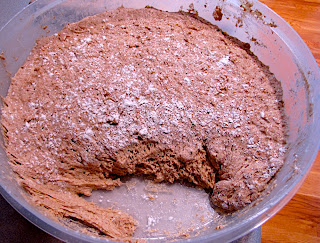
By this time I was getting a little better at shaping the loaves.

Because the loaf is supposed to be formed in only 20 to 40 seconds if there is a major malformation it's probably unwise to try to correct it.


The second loaf was better shaped and also small, at only 11 ounces baked. I baked it on parchment paper in a preheated dutch oven, uncovered. Oven spring was quite good. For a loaf that fits this is far better than a cookie sheet.

The third loaf was considerably larger at over 17 ounces baked and also fairly well shaped. And, my new baking stone had arrived. Oven spring was good, but I think the stone needed more preheating. It's much thicker than my old pizza stone.

For the fourth loaf I tried the garlic-studded baguette recipe. It was my first attempt at the letter-fold method and it did not go very well. For one thing, I should have made a smaller loaf; this one suffered quite a bit of abuse. For another, I tried using a pizza peel and even though it was liberally cornmealed the loaf offered considerable resistance to my dislodgement efforts. The result was unattractively irregular, to say the least. Also, I did not shove the garlic down deeply enough to keep it from popping out.

As for flavor, pretty uninspired. The garlic doesn't really contribute anything to any slice that doesn't have a piece.
So, what is my assessment at this point? The method is definitely low-effort. I can produce a pretty decent basic loaf and it really does require but five minutes of active effort on baking day. On the day it's baked the crust is excellent; after that it loses its crispness. (This may be a sign of slight underbaking, actually.) It has a relatively dense crumb. It keeps well for a couple of days or more. Flavor from these two basic recipes is underwhelming. I didn't think any sourdough flavors ever developed to a meaningful degree. It makes pretty tasty toast.
Will I keep doing this? Yes, I think I will. I'll keep working my way through the book and I'm sure some of the recipes will be more interesting. And at the very least this is a way to have fresh bread on any given day with very little effort and not too much wall time either.
I started with the first recipe, for the whole grain artisan free form loaf:
- 720 grams (5.5 cups) whole wheat flour
- 270 grams (2 cups) unbleached AP flour
- 15 grams (1.5 tablespoons) granulated yeast
- 15 grams (1 tablespoon) Kosher salt (calibrated for Morton's)
- 35 grams (1/4 cup) vital wheat gluten
- 900 grams (4 cups) lukewarm water
It rapidly doubled or tripled in size, at which point it refrigerated it. The next day I made two small loaves, one plain and one sprinkled with a dry Tuscan herb mix. I need a new and less broken pizza stone so this time I baked on a greased hollow-core cookie sheet.
This is the first time I've tried steam baking. Between two and three cups of ice cubes on a broiler pan provided steam for perhaps 25 minutes, but took a few minutes to get going. It would be better to give the ice a head start before inserting the loaves. I also tried hot tap water for subsequent loaves; I think this is superior as it produces steam almost immediately and is easier to quantify.
This dough spreads out quite a bit after being formed and resting for 90 minutes. I think my technique could have been better, resulting in a tighter loaf. However, oven spring was significant, as promised.

They baked at 460 for 30 minutes, which seemed about right. The crust is nicely crispy. Crumb was tender and not too dense. Flavor was a bit bland and undersalted, to my taste. This dough should develop sourdough characteristics over time, so a comparison in a few days will be interesting.

At five days I made another loaf. The refrigerated dough was weeping a bit, which is not a problem. This one came out pretty flat; I did not do a good job of shaping it or tucking the sides under. After 90 minutes of rising it was very wide and squat. The flavor was somewhat improved, I thought. Definitely needs salt.
The dough was six days old when I used the last of it. This time I floured the dough and my hands better and took more care in shaping the loaf while still doing it in under 20 seconds. More flour is a big help, and I think also helps the dough hold its shape while rising.
This time I baked for 20 minutes on the cookie sheet, then 10 minutes on the rack. The top crusts so far had been great, but with pallid bottoms. This helped a little, but what I really need is a new stone. In the meantime I should try rising on parchment paper and baking in the dutch oven.

The last loaf turned out the best although it was still irregularly shaped and proportioned. Tucking the sides completely and evenly may be the key to avoiding this, for even though the loaf initially looks perfectly symmetrical the manner in which it rises and springs reveals the internal inconsistencies. I'll have to try the letter-fold technique, too. Also, this loaf was a little larger (17 ounces after baking) and perhaps that causes it to collapse a bit under its own weight.

For the second dough I chose the 100% whole wheat with olive oil:
- 910 grams whole wheat flour
- 15 grams granulated yeast
- 15 grams kosher salt
- 35 grams vital wheat gluten
- 790 grams lukewarm water
- 110 grams olive oil

By this time I was getting a little better at shaping the loaves.

Because the loaf is supposed to be formed in only 20 to 40 seconds if there is a major malformation it's probably unwise to try to correct it.


The second loaf was better shaped and also small, at only 11 ounces baked. I baked it on parchment paper in a preheated dutch oven, uncovered. Oven spring was quite good. For a loaf that fits this is far better than a cookie sheet.

The third loaf was considerably larger at over 17 ounces baked and also fairly well shaped. And, my new baking stone had arrived. Oven spring was good, but I think the stone needed more preheating. It's much thicker than my old pizza stone.

For the fourth loaf I tried the garlic-studded baguette recipe. It was my first attempt at the letter-fold method and it did not go very well. For one thing, I should have made a smaller loaf; this one suffered quite a bit of abuse. For another, I tried using a pizza peel and even though it was liberally cornmealed the loaf offered considerable resistance to my dislodgement efforts. The result was unattractively irregular, to say the least. Also, I did not shove the garlic down deeply enough to keep it from popping out.

As for flavor, pretty uninspired. The garlic doesn't really contribute anything to any slice that doesn't have a piece.
So, what is my assessment at this point? The method is definitely low-effort. I can produce a pretty decent basic loaf and it really does require but five minutes of active effort on baking day. On the day it's baked the crust is excellent; after that it loses its crispness. (This may be a sign of slight underbaking, actually.) It has a relatively dense crumb. It keeps well for a couple of days or more. Flavor from these two basic recipes is underwhelming. I didn't think any sourdough flavors ever developed to a meaningful degree. It makes pretty tasty toast.
Will I keep doing this? Yes, I think I will. I'll keep working my way through the book and I'm sure some of the recipes will be more interesting. And at the very least this is a way to have fresh bread on any given day with very little effort and not too much wall time either.
Saturday, July 4, 2009
Seattle International Beerfest
I spent Friday afternoon and evening at the Seattle International Beerfest at the Seattle Center. There were 153 beers available, plus quite good music, and unbelievable weather for the first week of July in Seattle. I spoke to a few volunteers who seemed to be having a fine time. I might think about volunteering next year.
I tried:
There were many others I'd have liked to try but it was getting late, I ran out of cash, and I'd had plenty of beer for one day. I could easily spend all three days tasting.
I ran into Zach, a guy I met at my first North Seattle Homebrew club meeting (his first, too), and hung out with him and his wife, Jackie, for a while. He brought a Flanders Red sour beer to the club meeting, the first I'd ever had, and I loved it. I meant to try the Duchesse de Bourgogne Flanders Red for comparison but didn't get to it.
Of the four bands I saw, I really enjoyed Curtains For You, and Knut Bell & the Blue Collars.
I tried:
- Weinhenstephaner Hefe-Weissbier.
- Reissdorf Kolsch.
- Great Divide Double Wit.
- Cascade Gold Yeller Belgian Ale. This sour ale aged in French oak wine barrels was my favorite. Totally loved it. Too bad there's no way to get it without going to the Raccoon Lodge brewpub in Beaverton. It looks like it may be a one-time creation, too. I will definitely undertake an exploration of sour ales.
- Henney's Vintage Cider. Excellent. Really smooth, low carbonation, slightly bitter finish.
- Ace Joker Strong Cider. Not bad. Dry and incredibly pale. I wonder how they get that color.
- JW Lees Lagavulin. This was 6 tickets. It's an English barleywine aged in Lagavulin whisky casks. Very rich, sweet, smooth, and with a subtle Scotch flavor. I liked it but would not pay what I think the 9 ounce bottles cost.
- Dupont Avril Table Bier. I probably should have done some palate scrubbing after the barleywine before trying this saison. Not much to it.
- Alagash FOUR.
- Urthel Hop-It. This is supposed to be a hoppy strong Belgian pale, but I didn't find it to be all that hoppy. I wouldn't have guessed the claimed 80 IBUs, perhaps because of the overall balance.
- Old Lompoc LSD.
- Cascade Jellyroll. This chick beer seemed to be very popular so I tried it. It's a raspberry wheat, deliciously pink, super clean, and probably the best fruit beer I've had.
There were many others I'd have liked to try but it was getting late, I ran out of cash, and I'd had plenty of beer for one day. I could easily spend all three days tasting.
I ran into Zach, a guy I met at my first North Seattle Homebrew club meeting (his first, too), and hung out with him and his wife, Jackie, for a while. He brought a Flanders Red sour beer to the club meeting, the first I'd ever had, and I loved it. I meant to try the Duchesse de Bourgogne Flanders Red for comparison but didn't get to it.
Of the four bands I saw, I really enjoyed Curtains For You, and Knut Bell & the Blue Collars.
Friday, April 3, 2009
Belgian witbier tasting notes 4
St. Bernardus Wit was the last witbier remaining from my recent shopping excursions. Time to hit another specialty store for more.
The most interesting thing about this wit is that it was created with the assistance of Pierre Celis, the man responsible for resurrecting the style some decades back. It is bottle-conditioned, highly carbonated, and pours with an enormous, dense, and long-lasting head. More sour than most, considerably more wheaty, well-balanced, and subtle in its flavorings. It is the anti-Weinhard's. I really liked it but if I were tasting it alongside other witbiers I'm not sure I'd even identify it specifically as a wit.
The most interesting thing about this wit is that it was created with the assistance of Pierre Celis, the man responsible for resurrecting the style some decades back. It is bottle-conditioned, highly carbonated, and pours with an enormous, dense, and long-lasting head. More sour than most, considerably more wheaty, well-balanced, and subtle in its flavorings. It is the anti-Weinhard's. I really liked it but if I were tasting it alongside other witbiers I'm not sure I'd even identify it specifically as a wit.
Monday, March 30, 2009
Belgian witbier tasting notes 3
Tonight's entry in the Belgian witbier tasting series (part 1 and part 2) was the Brasserie du Bocq Blanche de Namur. It is bottle-conditioned, highly carbonated, has a rapidly diminishing head, and is brewed with licorice in addition to the orange rind and coriander. The licorice is a subtle but interesting and pleasant addition. It is very smooth and has an unusual dry mouthfeel. Good balance. It's low alcohol at 4.5% and quite quaffable. One of my favorites.
Saturday, March 28, 2009
Belgian witbier tasting notes 2
I picked up a few more Belgian witbiers at Big Star Beers the other day, continuing my survey of bottled wits. It was my first time there. Although the cashier was helpful (and very busy) the store's organization is not ideal for this particular quest. A list of what they have in stock would be useful for someone who is trying to track things down by style rather than country of origin or random principle that I did not quite grok. Of note, they did not carry Celis White, but the store's premise is that they while they carry 1000 beers they will also track things down for you. I should test that.
So far of these I've tried:
The Deschutes wit is fairly clear and very subtly flavored. I'm not sure it's a great example of the style. On the other hand, there are some examples that are so overbearingly spiced that they are unpleasant. I'll take this over those. I don't think this is bottle-conditioned. The head is comprised of fairly large bubbles and dies quickly. Certainly a worthy session beer.
So far of these I've tried:
The Deschutes wit is fairly clear and very subtly flavored. I'm not sure it's a great example of the style. On the other hand, there are some examples that are so overbearingly spiced that they are unpleasant. I'll take this over those. I don't think this is bottle-conditioned. The head is comprised of fairly large bubbles and dies quickly. Certainly a worthy session beer.
The Ommegang is much less subtle and extremely hazy, with a towering but not long-lasting head. Very good. It's bottle-conditioned, and the label instructions are to avoid picking up the yeast, unlike many others. I wonder what leads to the various recommendations.
The White Rascal is bottle-conditioned and nearly opaque. Yeast consumption is advised. It has a more persistent head and assertive spice flavors. I'd say it's right in the sweet spot of the style for my taste.
Sunday, March 22, 2009
Belgian witbier tasting notes
This weekend I've been tasting all of the bottled Belgian witbiers I can find. So far, that is:
I was surprised by how much I liked the Sam Adams mainly because I have never had a single Sam Adams beer before this that I enjoyed much. I've had probably six or seven types, on draft and in bottles, most recently the Christmas seasonal pack. I don't know what they all have in common, but there is some flavor component that just does not do it for me. The white ale, however, is not bad at all. It is darker than the Hoegaarden and New Belgium, more subtle in its flavorings, and has a lot of particulates. It doesn't make me jump up and down like a little girl with a new Growing Up Skipper doll but it's very drinkable.
As for the Henry Weinhard's... holy squatting three-legged dog in my yard. It is an abomination. It smells like Orange Crush, is a perfectly clear orangey color, and tastes like a bitter old orange peel. The flavor really is close to an orange that has begun to go bad and has acquired that terrible combination of overripe sweetness and spoiled bitterness.
I wonder whether I can find Celis White at one of the specialty shops like Big Star (worst web site since 1994). Full Throttle Bottles doesn't have it, but does have a few others to try.
Update on the Sam Adams: I had it on draft recently and it was very nice. I'd still take a draft Hoegaarden if given the choice, but it was quite serviceable.
- Hoegaarden witbier
- New Belgium Mothership Wit
- Blue Moon
- Samuel Adams white ale
- Henry Weinhard's Belgian style wheat
I was surprised by how much I liked the Sam Adams mainly because I have never had a single Sam Adams beer before this that I enjoyed much. I've had probably six or seven types, on draft and in bottles, most recently the Christmas seasonal pack. I don't know what they all have in common, but there is some flavor component that just does not do it for me. The white ale, however, is not bad at all. It is darker than the Hoegaarden and New Belgium, more subtle in its flavorings, and has a lot of particulates. It doesn't make me jump up and down like a little girl with a new Growing Up Skipper doll but it's very drinkable.
As for the Henry Weinhard's... holy squatting three-legged dog in my yard. It is an abomination. It smells like Orange Crush, is a perfectly clear orangey color, and tastes like a bitter old orange peel. The flavor really is close to an orange that has begun to go bad and has acquired that terrible combination of overripe sweetness and spoiled bitterness.
I wonder whether I can find Celis White at one of the specialty shops like Big Star (worst web site since 1994). Full Throttle Bottles doesn't have it, but does have a few others to try.
Update on the Sam Adams: I had it on draft recently and it was very nice. I'd still take a draft Hoegaarden if given the choice, but it was quite serviceable.
Subscribe to:
Posts (Atom)